Finding Meaning in Caregiving Through Poetry: A Conversation with Author Wendy Drexler
A Q&A on “Harvest of What Remains,” a poetry collection reflecting on caring for a loved one with Alzheimer’s disease.
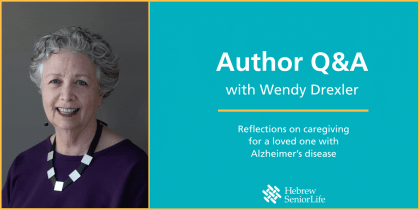
Caregiving isn’t an easy experience to put into words. In her latest poetry collection, “Harvest of What Remains,” Wendy Drexler does just that, offering a deeply personal and touching reflection on caring for her husband with Alzheimer’s disease.
The book also holds a meaningful connection to Hebrew SeniorLife. Drexler’s husband was treated by Alvaro Pascual-Leone, MD, PhD, medical director of the Deanna and Sidney Wolk Center for Memory Health, who wrote the foreword to the collection.
In a conversation for the Hebrew SeniorLife blog, Drexler shared her journey into poetry, how writing helped shape her caregiving experience, and what she hopes others will take from her latest collection.
How did writing poetry shape your caregiving experience?
“I was writing these poems as I was living the caregiving experience. Writing definitely helped me on this caregiving journey by giving me a chance to reflect more deeply on what I was going through.
As a caregiver, there are moments when you feel very alone. You don’t often have time to reflect or process your feelings, so you push them under the rug and just keep going. But those feelings don’t just disappear. It was a gift to me to be able to reach down and find them.
In one poem, ‘In The Kitchen,’ I describe a moment where my husband was looking for something in the kitchen, as I waited to see if he could find it himself. I try to be as gentle as possible when I do offer help, ‘shrinking my voice to the size of a seed, so my tone will seem anecdotal, incidental, nondirective,’ then I stand there as he pours himself some juice, watching him do what he still can.
Moments like that are part of what Alzheimer’s caregivers navigate every single day. Writing about that helped me unpack that, and my feelings around it.”
You use a technique you call “Sapphic fragments.” Can you describe that approach?
“The reconstructed sapphic fragments in my book are a form I created using fragments translated by Anne Carson, a brilliant poet and essayist. Much of the ancient Greek poet Sappho’s poetry only survives in small, incomplete fragments.
I took these translated fragments and wrote into them, enveloping my own poems around her words. What surprised me in creating these reconstructions was that I found myself consoling and guiding myself as a caregiver in the process. It was a way of gently supporting myself through the challenges I was facing.”
You also created a second set of poems from those reconstructions by erasing parts of those fragments. Can you talk about that?
“Yes — it’s a process of erasure, which is also a metaphor for dementia. These erasure poems were also revelatory. I approached them very intuitively, removing words and seeing what remained.
If the reconstructed fragments became a place of refuge or consolation, the erasure revealed the raw underbelly of the disease.”
Your collection also includes symbolic visual artwork. What does that represent?
“I collaborated with the visual artist Connie Saems, who envisioned two strands that are present throughout the book. One represents my journey, and one represents my husband’s. These strands are letter drawings made from the titles of my poems.
In the earlier sections of the collection, the strands are more intact. But as the book progresses, my husband’s strand becomes increasingly undone, while mine stays intact. His strand has nearly disintegrated by the end of the book, symbolic of his Alzheimer’s disease.”
Your book explores a wide range of emotions that caregivers experience. What were you trying to convey to readers?
“I do think love is the underlying emotion, which I didn’t see for quite a while, but that is definitely the primary focus, and I’m glad that comes through, because there is certainly anger, stress, anticipatory grief, worry, and fear.
It was so gratifying to be able to create something that had meaning for me and was beautiful, and even more so to be able to offer something meaningful to caregivers and anyone dealing with challenging situations.”
Your husband was treated by Dr. Alvaro Pascual-Leone at the Wolk Center for Memory Health. What guidance from him stood out most?
“I’m grateful to Dr. Alvaro Pascual-Leone for the generous amount of time he always spent with us during our appointments, patiently eliciting responses from both my husband and me to his questions and responding to my questions and concerns, and for deepening and informing my understanding of how Alzheimer’s affects the brain and how the disease progresses.
His recommendation that the best way to preserve cognitive reserve was to ‘try something you've never done before’ was especially helpful. As a result, my husband began taking piano lessons — we had an untouched piano at home.
I recall Dr. Pascual-Leone said he wanted my husband to ‘practice badly, every day,’ explaining that new brain activities create new neural pathways. Not only have piano lessons likely helped maintain my husband’s cognitive reserves, but they have given him a great deal of pleasure. Now in memory care, he continues to take a lesson once a week.
I resonated with his use of metaphor. In my poem ‘My Husband’s Neurologist Responds to My Questions About Alzheimer’s and the Uncanny Valley,’ I used the gist of Dr. Pascual-Leone’s own highway metaphor to explain how far the synapses have to travel to remember how to find the tea bags in the kitchen.”
Finding words to capture the caregiving experience
While preparing to speak with Drexler about “Harvest of What Remains,” I was chatting with a close family member caring for a parent with Alzheimer’s disease. She was overwhelmed after a particularly heavy day.
With Drexler’s poetry fresh in my mind, I shared a poem that echoed a challenge my family member had described to me earlier. It’s called “Notes From My Stress Journal”:
If I’m to write what’s hardest—maybe
it’s what comes after I’ve spent eight hours
away from you with friends, a museum
lunch, a little shopping, in a store where
I stroke the stout and soft bristles and lean
wooden handles of brushes made in Germany
that can do everything—wipe up crumbs,
scrub nails and vegetables, brush your hair,
your face, sweep coffee grounds, or ashes
then returning home, happy, exhausted, I take
a nap, wake in dusk to having to be your
everything again, the weight of what to make
leftovers—shrimp curry in coconut milk,
only the microwave’s small labor—and after,
listening with as much patience as I can as you
tell me about your day: the rain and the woman
who covered her small dog with her umbrella…
the woman, the umbrella, the rain, the small dog,
the small dog, the umbrella, the rain, the woman.
A few days later, when we spoke again, my family member said: “It’s been one of those days… dog, umbrella, dog, umbrella.”
Not only did the poem resonate, but it helped her put into words what caregiving feels like in a way that I could relate to. Drexler’s ability to give people language for what’s often hard to express is part of what makes this collection so powerful.
Seeking memory care or caregiver support?
For those navigating caregiving, having the right support can be an important part of the journey. If you or a loved one is noticing changes in memory or thinking, seeking support early can make a meaningful difference. The sooner you reach out, the more options may be available to you.
At Hebrew SeniorLife’s Wolk Center for Memory Health, our multidisciplinary team provides comprehensive, personalized care across all stages of memory loss. We also offer support and resources for caregivers, recognizing the crucial role they play in the care journey. If you’d like to learn more, call 617-363-8600 or contact us online today.
Blog Topics
Learn More
Coping with Memory Loss
From our Wolk Center for Memory Health to Assisted Living to Memory Care Assisted Living, we offer a wide range of memory care services and support.