What Women Should Know About Osteoporosis After Menopause
Learn how menopause affects your bones and how early screening and treatment can help protect them.
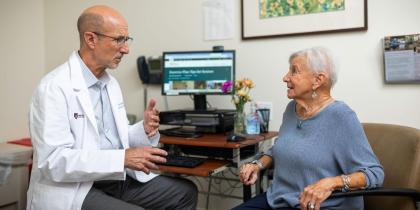
Hot flashes may be one of the most well-recognized signs of menopause, but declining hormone levels can affect the body in ways you may not always notice — including in your bones.
Bone loss accelerates as estrogen levels drop during menopause, which can lead to osteoporosis. Because osteoporosis has no symptoms in the early stages and is often diagnosed after a fracture, it is sometimes referred to as a “silent disease.”
As the director of the Musculoskeletal Research Center and a senior scientist at the Hinda and Arthur Marcus Institute for Aging Research, I’ve spent my career studying osteoporosis and its related fractures. Let’s talk about how menopause affects your bone health, the importance of preventive screenings, and how physicians treat osteoporosis.
Why does osteoporosis risk increase after menopause?
Osteoporosis gradually weakens your bones, making them more likely to break from a minor fall or accident. If you slip from a standing height and fracture a bone, it can be tempting to dismiss it as bad luck. But a fracture from this type of fall is often the first visible sign of bone loss.
Both women and men can develop osteoporosis, but women are at greater risk. According to the Bone Health & Osteoporosis Foundation, women account for 80% of the 10 million Americans with osteoporosis. Approximately half of women over age 50 will break a bone due to osteoporosis.
While our skeletons may seem permanent, our bodies are constantly reabsorbing old bone and forming new bone in its place. Estrogen helps keep these processes balanced. During perimenopause, which is the transitional period before menopause, estrogen levels begin to fluctuate and decline. As a result, the body may begin to break down old bone faster than it forms new bone.
Once you reach menopause, your estrogen levels drop significantly and remain lower than before. Because of that, bone loss often speeds up during the first years after your menstrual cycle ends.
When should you be screened for osteoporosis?
A combination of genetics and lifestyle influences your bone density. Think of it like a bank account: Not everyone builds up the same amount of bone earlier in life, so women reach menopause with different levels in reserve. As bone loss accelerates, some people’s reserves may dip so low that they’re at risk for osteoporosis.
That’s why it’s important to understand your risk level before a fracture happens. Women should generally be screened for osteoporosis beginning at age 65. Medicare Part B covers bone mass measurements once every 24 months for people who meet certain eligibility requirements.
If you break a bone after a seemingly minor fall, you should speak with your doctor about an osteoporosis evaluation, regardless of your age. What may seem like a fluke or unlucky accident may actually have been the first visible sign that your bones have become fragile.
Screening typically includes a DEXA scan to measure your bone density, along with a FRAX assessment to estimate your 10-year fracture risk. Your doctor will look at both results to decide whether you need additional treatment or just monitoring.
What osteoporosis treatment options are available?
Before starting a medication, your doctor may talk with you about why it is an important part of your care plan. When thinking about keeping your bones strong, calcium, vitamin D, and protein may come to mind first. These nutrients are important, but they’re often not enough to treat osteoporosis on their own.
I sometimes compare building bones to building a brick wall. Good nutrition lays an important foundation, while osteoporosis medications can help your body build new bone or reinforce the bone you already have.
A physician can then recommend a medication based on your fracture risk, current bone density, and the urgency of improving that density. Osteoporosis medications belong to two main classes:
- Anabolic medications stimulate new bone formation and increase bone density more rapidly. Most anabolic therapies are used for 12 to 24 months for women at very high risk of fracture, followed by an antiresorptive medication to preserve gains.
- Antiresorptive medications slow the rate at which the body breaks down bone. Women at lower fracture risk who still need medication may begin with an antiresorptive drug.
It is never “too late” to consider osteoporosis treatment. A 2024 analysis of 23 clinical trials found that osteoporosis medications work just as well at reducing fracture risk in people 70 and older as in those under 70. In fact, older study participants experienced greater increases in bone density over two years.
The importance of preventing a second fracture
Throughout my career, I have been especially passionate about secondary fracture prevention. That means treating the underlying osteoporosis after someone has broken a bone to prevent another fracture.
A hip fracture is a clear signal that your bone health needs attention. While surgery and rehabilitation address the immediate injury, care should also include an osteoporosis evaluation and medication to reduce the risk of another fracture. Just like someone recovering from a heart attack typically leaves the hospital with a care plan to prevent another one, people recovering from hip fractures need a prevention plan.
Learn more about how the right care after a hip fracture can help prevent a future fall.
Schedule an osteoporosis screening in Boston
Our outpatient health care clinics at Hebrew Rehabilitation Center in Boston are open to older adults throughout the Greater Boston area. Our clinic provides screening to help detect osteoporosis before a fracture occurs, predict your chances of a future fracture, determine your rate of bone loss, and monitor treatment.
We offer state-of-the-art bone mineral density testing, follow-up services, and referrals to physical therapy when needed. For more information or to schedule an appointment, call our outpatient therapy clinic at 617-363-8539.
Blog Topics
Learn More
Outpatient Services
Our outpatient health care clinics at Hebrew Rehabilitation Center in Boston offer a variety of services, including memory evaluations, osteoporosis screenings, and audiology.