Managing Arthritis Pain and Staying Active as You Age
Learn at-home exercises from a licensed physical therapist to ease pain and stiffness.
Arthritis is a painful and debilitating condition common among older adults. Symptoms like chronic pain and joint stiffness can make it hard to stay active and do the things that matter most.
Fortunately, there are ways to manage arthritis symptoms and support mobility, including at-home exercises and physical therapy. As the outpatient physical therapy team leader at NewBridge on the Charles in Dedham, MA, I have helped many older adults with arthritis return to the activities and experiences that they value. Here is what you should know about arthritis, plus my tips for managing its symptoms.
What is arthritis?
Arthritis is a general term for joint disease that causes swelling, pain, and stiffness. Based on new estimates, 92.1 million adults in the United States either have doctor-diagnosed arthritis or report joint symptoms consistent with arthritis.
There are more than 100 types of arthritis. The most common form of arthritis is osteoarthritis, often referred to as OA or “wear and tear” arthritis.
Severe arthritis can cause functional disability, loss of joint motion and overall strength, sleep disturbances, and depression. Osteoarthritis is a chronic condition that can affect any joint, but it occurs most often in the knees, hips, lower back, neck, small joints of the fingers, and at the bases of the thumbs and big toes. Our blog post on arthritis and foot health covers arthritis in the feet and offers tips for managing foot pain.
What causes osteoarthritis?
We don’t fully understand the cause of osteoarthritis, but it is prevalent among people who have been injured or have regularly engaged in sports or leisure activities that involve repetitive joint use.
Joints have a protective lining of cartilage that forms a slippery, frictionless surface, providing cushioning and lubrication to ease joint movements. Osteoarthritis develops when this lining breaks down over time, resulting in bone spurs, tears, and eventually worn-away areas that cause bone to rub against bone.
Age, obesity, genetics, gender, bone density, and injuries can all contribute to the onset and progression of osteoarthritis. Women are more likely to develop osteoarthritis than men, and the risk increases with age.
Arthritis is diagnosed based on clinical signs of joint pain, swelling, and loss of range of motion, and on x-rays or MRIs to identify degenerative changes in the joints, including loss of joint space, bone spurs, and cartilage damage.
The impact of arthritis in older adults
Arthritis can impact an individual’s ability to perform basic activities of daily living, such as showering, dressing, and managing mobility. Often, individuals with chronic arthritis have difficulty getting up from chairs, getting in and out of bed, walking, and sometimes even standing.
Pain can have a significant negative effect on daily life and is a major complaint that brings patients to physical therapy. Many people with osteoarthritis say the pain, fatigue, degenerative changes to joints, and mobility limitations lead to social isolation, which may impact relationships.
Many of my patients report sleep disturbances that lead to poor concentration and depression. Joint deformity that can result from osteoarthritis often requires a brace or devices such as a cane or walker, which can affect emotional well-being for those adjusting to the change.
Arthritis can also limit a person’s ability to walk far enough or long enough to engage in activities like traveling, visiting museums, and simply getting around in their community. Individuals with arthritis often feel unsteady and are at higher risk for injury from events such as a fall.
And finally, those with osteoarthritis are more likely to have other health conditions, including obesity, diabetes, and heart disease.
While there is currently no cure for arthritis, there are treatments that can improve symptoms.
Tips for managing osteoarthritis
Strategies you can use to manage osteoarthritis include:
- Protect joints in the hands and arms by using a device to reach for objects, adaptive equipment designed to assist with opening cans, zipper aids, button fasteners, and padded, larger-grip handles.
- Take pressure off hip, knee, and ankle joints with good supportive shoes.
- Use a cane or walker to get around.
- Avoid stairs when possible.
- Avoid sitting for extended periods (no more than one hour at a time).
- Use a chair with arms, a raised toilet, and a shower chair to take stress off leg joints.
- Avoid repetitive squatting, bending, or kneeling.
- Use long-handled cleaning devices or a reacher device to pick up objects from the floor.
- Pace yourself when performing daily activities.
- Avoid painful movements as much as possible to help maintain function.
Exercise is the best treatment
Physical therapy and exercises are the most important and effective treatments for osteoarthritis. Patients can also be treated with pain and anti-inflammatory medications, cortisone injections into the joints for temporary relief, or total joint replacements if conservative treatments aren’t effective.
Many people who come to physical therapy are looking to improve their ability to join in activities with family and friends. They often want to improve their walking tolerance so they can participate in a family wedding or travel.
I’ve had patients who’ve been able to go on lifetime dream trips after receiving physical therapy. Others have been able to set aside their walkers in favor of canes. With joint replacement and physical therapy, some have been able to progress to the point of no longer using mobility aids they used for years.
Osteoarthritis can often be managed at home with exercises, heating pads, and ice packs.
Best exercises for arthritis
Low-impact exercises, such as walking, biking, and swimming, help motivate people and keep them moving. Running, jogging, jumping rope, high-impact aerobics, or any other exercise where both feet are off the ground at the same time should be avoided.
Remember to speak to your physician before starting a new exercise routine to manage pain. If you’re having trouble exercising comfortably at home, make an appointment with your doctor to discuss your options.
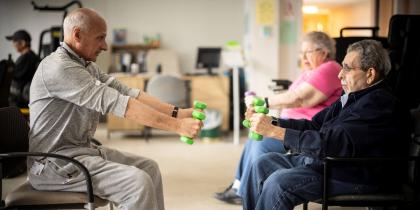
That said, engaging in gentle movement can help relieve arthritis symptoms for many people. Here are some exercises that I recommend to my patients to manage osteoarthritis.
Exercises for knee pain
- Sit and straighten one knee. Tighten your thigh muscle and hold for 10 seconds. Repeat 10 times.
- While seated, bend your knee underneath your chair as comfortably as you can. Hold for 10 seconds and repeat 10 times with each leg.
Exercises for hip pain
- Stand while holding on to a sturdy chair or countertop for support. March in place, alternating your legs, lifting each leg as high as you comfortably can.
- Stand while holding on to a solid support, then swing one leg out to the side while keeping your knees straight. Repeat 10 times with each leg.
Exercises for upper body pain
- Roll your shoulders back and then gently squeeze your shoulder blades together. Repeat 10 times.
- Stand with a slight bend forward and let one arm hang toward the floor. Gently move your arm in a circular motion, drawing small circles with your hand (also known as pendulums). Complete 10 circles with each arm.
An exercise to strengthen the ankles
- Hold onto a sturdy support and raise your heels as high as you can comfortably. Hold for 10 seconds and repeat 10 times.
An exercise to strengthen and stretch legs
- Stand facing the wall and place your hands against it for support. Step one leg behind you, keeping your heel on the floor until you feel a gentle stretch in the calf. Hold for 10 seconds and repeat with the other leg.
What should you do if you think you have arthritis?
If you suspect that you have arthritis, you should consult your primary care physician. They can provide treatment and/or refer you to a specialist and other care professionals, such as physical therapists.
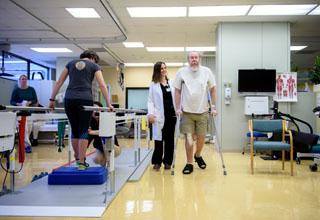
Hebrew SeniorLife specializes in adult physical therapy using state-of-the-art mobility and treatment equipment, including manual therapy, joint mobilization, and therapeutic modalities to maximize function and independence. Outpatient physical therapy services are available at Hebrew Rehabilitation Center in Boston and Hebrew Rehabilitation Center at NewBridge on the Charles. Our services are open to all residents of Boston and the surrounding communities.
Learn more about outpatient physical therapy at Hebrew SeniorLife or contact us online today.
Blog Topics
Learn More
Outpatient Rehabilitative Therapies
At Hebrew Rehabilitation Center in Boston and Dedham, MA, we offer adult physical therapy, occupational therapy, and speech therapy using state-of-the-art mobility and treatment equipment.