Stories of What Matters Most: Honoring the Person Behind the Medical Chart
Adding patients’ life stories to their medical records helps keep their voices, values, and priorities at the heart of their care.

Medical records contain almost everything about someone’s health. They track medications, surgeries, and numerous lab tests. Yet they often reveal very little about the person behind those records: who they love, what they value, or the contributions they have made throughout their lives.
When physicians take the time to speak with their patients about what matters to them, it can help patients feel seen and heard.
As an advanced geriatrics fellow at Hebrew SeniorLife through the Harvard Medical School Multi-Campus Fellowship in Geriatric Medicine, I worked on a project to better understand what matters to the patients in our care.
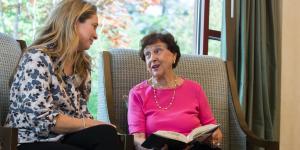
The Life Story Project focuses on conducting interviews with long-term chronic care patients and their families about their lives and including summaries of those conversations in the patients’ medical charts. Hearing their stories reminds me why I chose to be a geriatrician: to care for people rather than focusing only on diseases.
Why life stories matter in long-term care
Imagine the following scenario inspired by the many conversations we have had throughout the Life Story Project. The story is hypothetical to protect our patients’ privacy.
A patient with late-stage cancer is determined to continue physical therapy. From a clinical perspective, the benefits may appear limited because the disease has significantly affected the patient’s mobility.
During a Life Story Project conversation, however, the patient shares that they helped raise their grandchild and hope to attend the grandchild’s upcoming wedding. Physical therapy isn’t simply about strength or mobility — it represents the possibility of being present for one of the most important days in their loved one’s life.
With that understanding, the care team can develop a mobility plan around the patient’s deeply personal goal, aligning their care more closely with what matters most to them.
Once everyone is on the same page about the “why” behind a request, it becomes easier to work together toward shared goals, build trust, and look past what is already in a medical chart.
This story demonstrates a broader principle: understanding a patient’s life story provides context that can guide thoughtful medical care as health needs become more complex. As people develop multiple medical conditions, decisions become less straightforward, and treatments often involve trade-offs.
One person may prioritize prolonging life, even if it means undergoing more procedures, making additional hospital visits, or experiencing discomfort. Another may prioritize comfort and independence. There is no universal answer, and the best decision depends on what matters most to each person.
Priorities vary from patient to patient. I can only suggest a treatment plan if I understand a patient’s values. I have yet to meet a patient whose ultimate goal is simply to lower their cholesterol or achieve an ideal sodium level. Clinical goals like these should support a larger purpose that matters to the patient.
Goals are formed based on life experiences and what matters to an individual: an upcoming graduation dinner, celebrating the next holiday season, or being free of pain. These are often what people care about, and when we understand these goals, we can align the medical care plan with them.
About the Life Story Project
In Life Story Project interviews, we ask questions such as what someone’s childhood was like, what they did for a living, and who the important people in their lives are. The patient or family member controls how much information is shared. We encourage patients to share only what is comfortable. Interviews last approximately 20-30 minutes. This is the patient’s opportunity to have their voice included in their medical chart.
During these interviews, we ask deep questions, such as what matters most to an individual, what they are most proud of, or what they want the care team to know. These are valuable pieces of information because they allow the health care team to tailor care.
The interviewer takes notes on the conversation and types them into a short document. We prefer to use the first person to preserve patients’ voices and expressions. For example, it might begin, “I was born in Boston. ...” We keep the document short to encourage as many members of the health care team as possible to read and review it.
The final narrative is read to the patient and edited based on the patient’s feedback if needed. The document is then added to the patient’s electronic health record and can be accessed by their health care team for deeper insights that are incorporated into their care.
Advancing person-centered care at Hebrew Rehabilitation Center
At Hebrew Rehabilitation Center, caring for older adults means more than understanding a diagnosis. It means taking time to learn about the person behind the medical chart.
Efforts like the Life Story Project strengthen our commitment to the Age-Friendly Health Systems framework (the 4Ms), which encourages care teams to routinely understand each patient's goals, values, and priorities, and to align care with them.
It is not always easy to understand what matters most to someone. That said, medical care is much more meaningful when grounded in this understanding. A request for more physical therapy, for example, may be rooted in what a patient hopes that therapy will make possible.
As I graduate from the Harvard Medical School Multi-Campus Fellowship in Geriatric Medicine, I am happy to leave behind the foundations for a project that will continue to grow in the hands of talented learners, volunteers, and staff. While the Life Story Project helps us discover what matters most to our patients, it also reflects what matters most to me as a geriatrician: building meaningful relationships with older adults and learning from their life stories.
Hebrew Rehabilitation Center’s long-term chronic care and rehabilitation services units in Boston and Dedham have both been recognized by the Institute for Healthcare Improvement as Age-Friendly Health Systems. Contact the admissions team online or call 617-363-8372 today to make a referral.
Blog Topics
Learn More
Long-Term Chronic Care
Hebrew Rehabilitation Center provides person-centered extended medical care in a homelike setting for patients with chronic illness. As a licensed long-term chronic care hospital, we provide higher-level, more comprehensive medical care to older adults than a traditional nursing home.

Hebrew Rehabilitation Center
Hebrew Rehabilitation Center provides skilled care and support after illness or surgery and offers long-term chronic care and specialized care for those with memory loss.