What the New Dietary Guidelines Mean for Healthy Aging
Take a closer look at what the new food pyramid and updated dietary guidelines from the USDA mean for older adults.

Older adults have lived through decades of U.S. food guidance, with each framework offering its own perspective on what a healthy diet should look like. Now, the 2025-2030 Dietary Guidelines for Americans include an updated visual tool — a newly designed food pyramid from the U.S. Departments of Agriculture and Health and Human Services — to help people put those recommendations into practice.
For some people, the new food pyramid and dietary guidelines may feel like one more set of recommendations to interpret after years of changing advice. However, the food pyramid doesn’t require relearning the fundamentals of nutrition. It’s about understanding how today’s guidance fits with what you already know, and recognizing what your body needs now.
As the dietetic internship coordinator and lead clinical dietitian at Hebrew Rehabilitation Center, I regularly work with older adults to assess their nutritional needs. At Hebrew Rehabilitation Center, our care is informed by decades of nutrition research from the Hinda and Arthur Marcus Institute for Aging Research.
Below, I’ll walk through the most notable elements of the new food guidelines and what they mean for older adults.
A closer look at new food guidance
The updated inverted food pyramid shows proteins, dairy, fats, fruits, and vegetables, with whole grains at the base. One of the strongest messages in the new dietary guidelines is an emphasis on whole, nutrient-dense foods. They also advise limiting or avoiding ultra-processed foods, such as packaged snacks and sugary drinks.
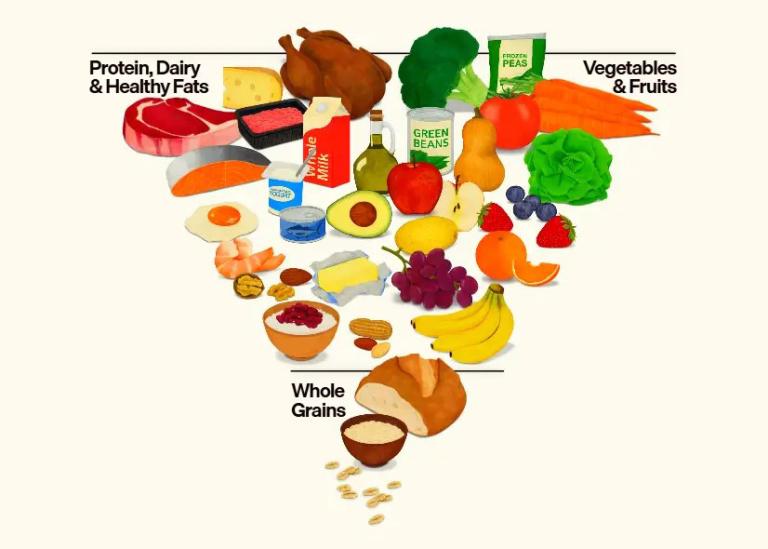
(Courtesy U.S. Department of Agriculture and U.S. Department of Health and Human Services)
At the same time, the category of ultra-processed foods isn’t straightforward. “A number of research studies have associated ultra-processed foods (as defined by NOVA classification) with chronic diseases. However, NOVA classification is quite broad, and we don’t have a perfect system for defining ultra-processed foods,” says Shivani Sahni, PhD, director of the Nutrition Program and associate scientist at the Marcus Institute.
While a majority of ultra-processed foods are low in nutrients, they aren’t all the same. Soda, candy bars, and donuts offer little nutritional value. Other foods in this category, such as store-bought yogurts, canned beans, plant-based milks, and protein bars, can still provide essential nutrients and may fit into a balanced diet.
Importantly, the pyramid displays fresh, frozen, dried, and canned fruits and vegetables. While fresh fruits and vegetables are great, these alternatives can be more affordable, plus easier to prepare, chew, and swallow. In New England, where some foods aren't always in season, options like frozen produce can help you include fruits and vegetables in your diet all year.
Protein and muscle health as we age
The updated guidelines recommend an increased protein intake of 1.2 to 1.6 grams per kilogram of body weight per day for all adults, up from the previous minimum of 0.8 grams per kilogram. For a 165-pound adult, this translates to around 90-120 grams of protein per day. While this range is appropriate for many older adults, it’s a good idea to speak with a registered dietitian to find out what’s right for you.
Dietitians had previously recommended a higher protein intake for older adults due to age-related changes in muscle health. As we age, we naturally lose muscle mass, strength, and function, which is a process known as sarcopenia.
Both sufficient protein intake and strength conditioning play essential roles in maintaining muscle strength and physical function. Studies from the Marcus Institute, including work by Shivani Sahni, PhD; Marian T. Hannan, DSc, MPH; and Douglas P. Kiel, MD, MPH, have shown that adequate dietary protein intake is linked to the maintenance of muscle mass and strength in older adults.
The guidelines highlight red meat more than in previous years, but protein should come from a variety of sources, including meat, fish, eggs, dairy, beans, lentils, nuts, seeds, and other plant-based foods. Including a mix of protein sources can help meet nutritional needs while accommodating your preferences, budget, and dietary needs.
Understanding saturated fat guidance
One area that requires careful balance is the guidance on saturated fat. The newest dietary guidelines continue to recommend that saturated fat make up no more than 10% of total daily calories. At the same time, some newly emphasized foods, including red meat, butter, and whole-fat dairy, are high in saturated fat.
Thinking about these recommendations together rather than in isolation is helpful. It can be challenging to stay within ideal limits if you’re eating large amounts of foods high in saturated fat.
This is especially important for people with certain health conditions. For example, the American Heart Association recommends limiting saturated fat intake to no more than 6% of total daily calories for people who need to lower their cholesterol. That’s why it’s important to remember portion size and balance across your diet.
Dairy intake, calcium, and bone health
The new guidelines suggest three servings of dairy per day, and highlight full-fat dairy as a good source of protein, vitamins, and minerals. Dairy is a key source of calcium, which supports bone health in older adults.
It’s helpful to know that whole milk, low-fat milk, and skim milk all contain similar amounts of calcium and protein. Research conducted by the Marcus Institute has also found that dairy intake is associated with higher bone mineral density in older men. More specifically, men with higher intakes of milk, yogurt, and cheese had greater bone mineral density.
At the same time, full-fat dairy contains more saturated fat than lower-fat milks. One cup of whole milk contains about 4.5 to five grams of saturated fat, accounting for roughly 20% of the recommended daily limit in a 2,000-calorie diet (and more if your calorie needs are lower). Consider varying the fat content of your dairy choices, especially if you enjoy other foods that are high in saturated fat, such as red meat or butter.
How nutrition needs shift with age and health
As we grow older, our bodies’ needs shift. The new nutrition guidelines briefly address this, noting that some older adults need fewer calories but still require the same or more protein, vitamin B12, vitamin D, and calcium. They also recognize that fortified foods or supplements may be helpful for some older adults under a health care provider’s supervision.
Many of the recommendations, such as prioritizing whole foods, limiting ultra-processed foods, and eating plenty of fruits and vegetables, can support overall health for people with certain chronic health conditions.
That said, this guidance is most effective when it’s tailored to individual health needs. For example, consuming red meat frequently can raise LDL (“bad”) cholesterol levels, which can be a concern for people already living with chronic conditions like heart disease.
Ultimately, good nutrition isn't about following a single set of guidelines. It’s about using everything we know to make informed choices that support long-term health.
Outpatient medical nutrition therapy at Hebrew Rehabilitation Center
If you or a loved one has questions about how to apply new dietary guidance to your health needs, the registered dietitians at Hebrew Rehabilitation Center are here to help. We developed our outpatient medical nutrition program for older adults to support a wide range of nutrition-related concerns, including chronic disease management and overall well-being.
To learn more, contact us online or call our outpatient nutrition therapy program at 617-363-8539 in Boston or 781-234-9630 in Dedham.
Blog Topics
Learn More
Outpatient Nutrition Therapy
As part of our specialty outpatient care, we offer one-on-one nutrition counseling at Hebrew Rehabilitation Center in Boston. Our Registered Dietitians, who specialize in the needs of older adults, will help you stay in overall good health or provide suggestions to manage or prevent specific health concerns.